



Engineering summary
QuakeLogic's single-axis 250 kg shake table: a 100 x 100 cm platform delivering 1g and 400 mm total stroke under EASYTEST control for research, teaching and certification.
In short: QuakeLogic's 250 kg uniaxial shake table is a single-axis electro-mechanical platform measuring 100 x 100 cm that accelerates a 250 kg specimen to 1g over a 200 mm stroke in each direction (400 mm total). Real-time feedback control and EASYTEST PC software let users set amplitude, frequency and duration to replay earthquake records or sine waves for structural research, teaching, product certification and retrofit studies.
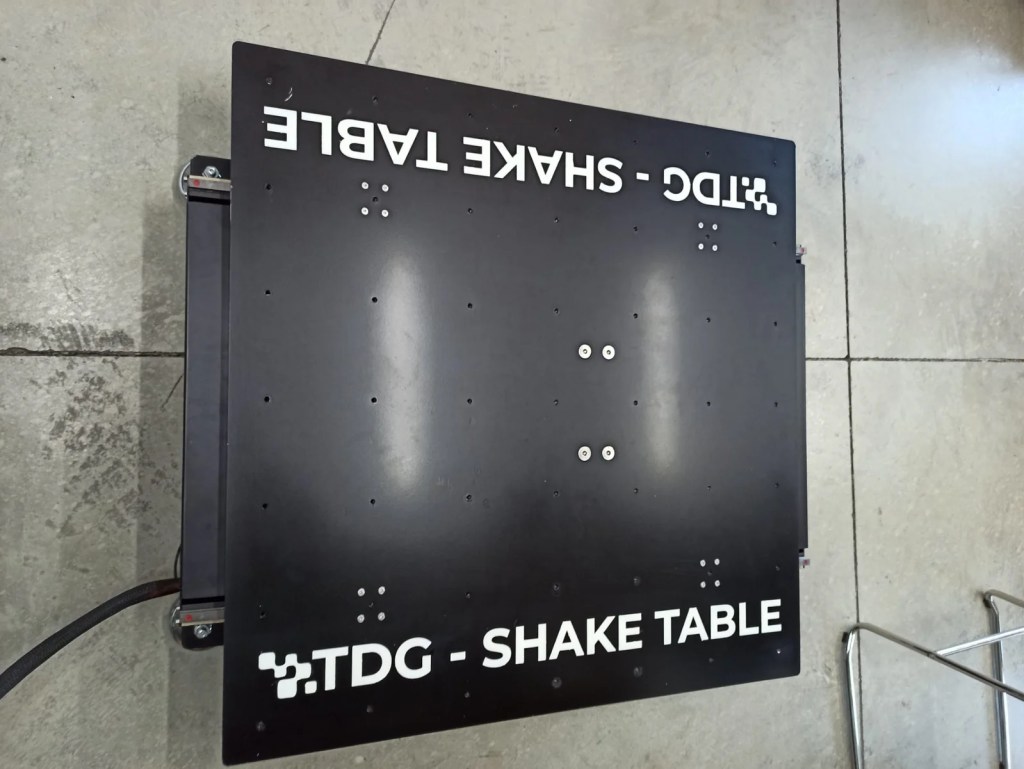
The QuakeLogic offers the 250-kg Shake Table, which is designed based on advanced engineering principles to simulate seismic activity for testing and research purposes. The structural framework consists of a robust, precision-engineered table platform supported by high-strength steel components. The platform can support up to 250 kg of test specimens.
The top table of the 1-axis system has dimensions of 100×100 cm (length by width) and a capacity of ±1g at 250 kg. It offers a stroke of ± 200 mm (total stroke of 400 mm) and operates using an electro-mechanical mechanism to generate precise and controlled movements. This system is integrated with high-fidelity sensor and actuator that translate electrical signals into physical motion, replicating the complex dynamics of earthquake waves. The control system uses real-time feedback mechanisms to ensure accuracy and repeatability of the simulations, making it an essential tool for structural and seismic testing.
Function:
The primary function of the 250-kg Shake Table is to provide a controlled environment for simulating seismic events. This equipment is designed to replicate ground motion by subjecting test specimens to a wide range of earthquake-induced vibrations in addition to signals such as sine wave, which are essential for comprehensive testing.
The product comes with EASYTEST PC control software, allowing for precise control and monitoring of the shake table’s operations. The EASYTEST is used for setting up test parameters, including the amplitude, frequency, and duration of the simulated earthquakes. This software enhances the usability of the system, making it accessible for both novice and experienced users.
Use Cases:
The QuakeLogic 250-kg Shake Table is used extensively in research, education, and industry for seismic testing and analysis. Its applications include:
- Structural Engineering Research: Universities and research institutions use the shake table to study the effects of earthquakes on various building materials and structural systems. This research is vital for developing new construction techniques and materials that can withstand seismic events.
- Civil Engineering Education: The shake table serves as a practical tool for educating civil engineering students about seismic design principles. It provides hands-on experience in understanding how structures behave under earthquake conditions.
- Seismic Certification and Testing: Manufacturers of construction materials and structural components utilize the shake table to certify their products’ seismic performance. This ensures that the products meet the necessary safety standards and regulatory requirements.
- Disaster Preparedness and Mitigation: Government agencies and organizations involved in disaster management use the shake table to develop and test mitigation strategies. This helps in improving building codes and enhancing the resilience of infrastructure against earthquakes.
- Commercial and Industrial Applications: The shake table is employed by engineering firms and construction companies for designing and testing innovative solutions for earthquake-resistant structures. This includes retrofitting existing buildings and designing new structures that comply with modern seismic standards.
Overall, the 250-kg Shake Table is an indispensable tool for advancing the understanding of seismic phenomena and improving the safety and resilience of structures in earthquake-prone regions.
To visit product page, click HERE.
For any further details or clarification, please do not hesitate to contact us directly at sales@quakelogic.net or call us at +1-916-899-0391.
Key Takeaways
- Platform 100 x 100 cm, payload up to 250 kg, acceleration 1g at full load, stroke 200 mm each way (400 mm total).
- Electro-mechanical drive with high-fidelity sensor and actuator and real-time feedback for repeatable motion.
- EASYTEST PC software sets amplitude, frequency and duration for earthquake records and sine-wave tests.
- Uses span structural research, civil engineering education, seismic certification, disaster mitigation and retrofit design.
Frequently Asked Questions
The 250 kg uniaxial shake table has a 100 x 100 cm top platform supported by high-strength steel components, carries test specimens up to 250 kg, reaches 1g acceleration at that payload, and provides a 200 mm stroke in each direction for a total travel of 400 mm. It is a single-axis, electro-mechanical system with a real-time feedback control loop and EASYTEST PC software.
The table replays earthquake-induced ground motions as well as synthetic signals such as sine waves. Typical tests include structural response studies of building materials and systems, hands-on seismic design demonstrations for civil engineering students, seismic certification of construction products and components, evaluation of mitigation strategies for building codes, and validation of retrofit and new earthquake-resistant designs.
Control is through QuakeLogic's EASYTEST PC software, which sets amplitude, frequency and duration of the simulated earthquake and monitors the run. Underneath, an electro-mechanical actuator translates the electrical command into motion while a high-fidelity sensor feeds back the platform response in real time, so the control system corrects the trajectory and keeps repeated tests consistent.
For many products, yes. Manufacturers of construction materials and structural components use the 250 kg uniaxial table to demonstrate seismic performance against safety standards and regulatory requirements along one horizontal axis. When a certification protocol requires simultaneous multi-axis excitation, a biaxial or triaxial table is needed instead, so the applicable standard should be checked before choosing the platform.
Related Articles
Need help with a project? QuakeLogic designs and supplies seismic monitoring, earthquake early warning, structural health monitoring, infrasound, and shake table systems. Browse QuakeLogic products or contact our engineering team with your site, structure, or test requirements.
Discover more from QuakeLogic
Subscribe to get the latest posts sent to your email.
Topic cluster
Related engineering knowledge areas
- Earthquake EngineeringSeismic hazard, ground motion, structural response, fragility, and resilience guidance.
- Structural Health MonitoringMonitoring for bridges, buildings, dams, tunnels, industrial facilities, and resilient infrastructure.
- Earthquake Early WarningOn-site detection, alerting workflows, seismic switches, and critical infrastructure warning systems.
- Infrasound MonitoringLow-frequency acoustic sensing for environmental noise, blast, UAV, volcano, and defense applications.
Definitions and references
Terms, standards, and source cues
- seismic hazard: related to Earthquake Engineering in this QuakeLogic knowledge cluster.
- ground motion: related to Earthquake Engineering in this QuakeLogic knowledge cluster.
- SHM: related to Structural Health Monitoring in this QuakeLogic knowledge cluster.
- damage detection: related to Structural Health Monitoring in this QuakeLogic knowledge cluster.
- earthquake early warning: related to Earthquake Early Warning in this QuakeLogic knowledge cluster.
- seismic switch: related to Earthquake Early Warning in this QuakeLogic knowledge cluster.
- infrasound sensors: related to Infrasound Monitoring in this QuakeLogic knowledge cluster.
- low-frequency noise: related to Infrasound Monitoring in this QuakeLogic knowledge cluster.
Need project support?
Talk with QuakeLogic about monitoring, testing, or warning systems.
Get engineering guidance for seismic monitoring, structural health monitoring, infrasound, vibration, earthquake early warning, and shake table applications.

