



Engineering summary
The ACEBOX is an all-in-one IP68 accelerograph with three force balance sensors, GPS timing and SeedLink streaming, installed at roof, mid-level and ground floor for building monitoring and EEW.
In short: The ACEBOX is an all-in-one accelerograph for building seismic monitoring that combines three SA10-series force balance accelerometers, an SL06 recorder, GPS timing and Ethernet in one IP68 corrosion-resistant aluminum case. Units are installed at roof, mid-level and ground level, stream SeedLink data at up to 10 packets per second for earthquake early warning, and run on-board P-wave alerting, frequency peak-picking and UNI9916 measurements.
QuakeLogic proudly presents the ACEBOX accelerographs, the ultimate solution for comprehensive building seismic monitoring. Our high-fidelity accelerographs feature triaxial force balance accelerometers, an integrated datalogger, GPS, and Ethernet capabilities.
These sophisticated instruments are strategically placed at the roof, mid-level, and ground level of buildings to ensure accurate and reliable seismic data collection, as shown in the schematic below.

The ACEBOX is a compact all-in-one high-resolution accelerograph based on the reliable and field-proven SL06 recorder. It embeds three force balance accelerometers of the SA10 series, allowing for efficient and fast deployment. Within seconds of activation, the system is operational. Encased in robust, corrosion-resistant aluminum, the ACEBOX can be deployed in the field indefinitely with minimal environmental protection. Its weight and durability guarantee excellent ground coupling, and flexible data connectivity allows direct linkage to your central observatory. The ultra-fast SeedLink server accelerates data streaming up to 10 packets per second, making the ACEBOX the best option for Earthquake Early Warning Systems (EEWS).

Key features of the SARA ACEBOX include:
- Ultra-low noise design with an embedded FBA sensor featuring ultra-low noise and cross-axis sensitivity
- GPS synchronization with options for PPS or NTP when GPS is unavailable
- Wide power supply voltage range and internal NiMh battery for safe shutdown on power failure
- Edge computing capabilities, including alerting algorithms like P-wave analysis
- Ultra-fast SeedLink streaming protocol or custom protocols with substreaming capability
- Networking options including TCP, SSH, FTP, HTTP, ModBus, MQTT, Telnet, Telegram, and SMS
- VPN readiness for operation behind firewalls and NAT filters
- High-capacity local data storage and real-time measurements according to the UNI9916 norm
- Automatic frequency peak-picking with frequency shifting alarm reports
- Easy web browser configuration and management
- IP68 protection grade for harsh environments
Applications for the ACEBOX include EEWS, aftershock studies, reservoir microseismic monitoring, operational modal analysis (OMA), and structural health monitoring (SHM).
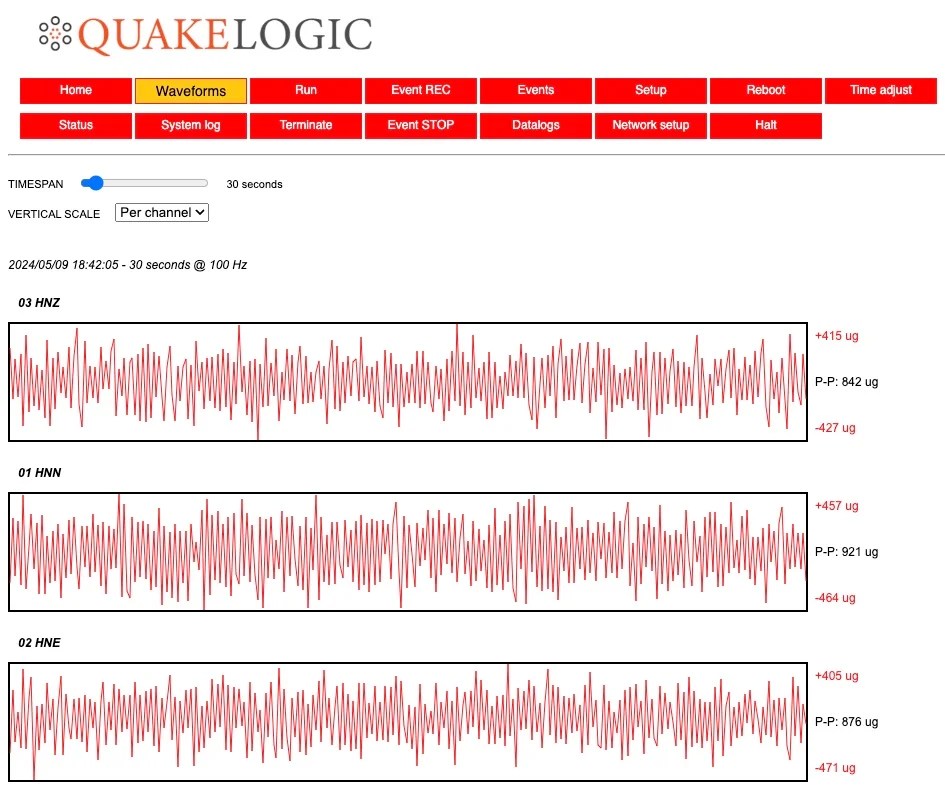
The GUI of ACEBOX is extremely easy to use and navigate.
Our accelerographs are designed to meet and exceed industry code regulations and standards, ensuring the highest level of safety and performance. The ACEBOX provides precise data essential for structural health monitoring and safety assessments, making it an invaluable tool for engineers and building managers.
For more information and sales inquiries, please contact us at sales@quakelogic.net or visit our product website at SARA ACEBOX Accelerographs.
About QuakeLogic
QuakeLogic is a leading provider of advanced seismic monitoring solutions, offering a range of products and services designed to enhance the accuracy and efficiency of seismic data acquisition and analysis. Our innovative technologies and expert support help organizations worldwide to better understand and mitigate the impacts of seismic events.
Contact Information
Emailto:sales@quakelogic.net
Phone: +1-916-899-0391
WhatsApp: +1-650-353-8627
Website: www.quakelogic.net
For more information about our products and services, please visit our website or contact our sales team. We are here to help you with all your seismic monitoring needs.
Thank you for choosing QuakeLogic. We look forward to assisting you with your seismic monitoring projects.
Key Takeaways
- ACEBOX embeds three SA10-series force balance accelerometers and the field-proven SL06 recorder in one IP68 aluminum enclosure.
- Typical building deployment places units at roof, mid-level and ground level.
- Ultra-fast SeedLink streaming at up to 10 packets per second suits earthquake early warning systems.
- Timing via GPS, with PPS or NTP fallback; an internal NiMH battery allows safe shutdown on power failure.
- Edge computing includes P-wave alerting, automatic frequency peak-picking with frequency-shift alarms and UNI9916 real-time measurements.
Frequently Asked Questions
The SARA ACEBOX is a compact, high-resolution accelerograph built on the SL06 recorder with three embedded SA10-series force balance accelerometers, GPS synchronization and Ethernet connectivity. It is housed in corrosion-resistant aluminum with IP68 protection, so it can be left in the field indefinitely with minimal shelter, and it becomes operational within seconds of power-up.
For building seismic monitoring, ACEBOX units are strategically placed at the roof, at a mid-level floor and at ground level. The ground unit records the input motion, while the mid-level and roof units capture how the structure amplifies and filters that motion, which is what engineers need for structural health monitoring, operational modal analysis and post-earthquake safety assessment.
The ACEBOX streams data through an ultra-fast SeedLink server at up to 10 packets per second, so a central observatory receives ground motion with very low latency. Its edge computing runs alerting algorithms such as P-wave analysis on the device itself, and it supports MQTT, ModBus, Telegram, SMS and other protocols for pushing alerts directly, which together make it a strong fit for EEWS.
The ACEBOX normally synchronizes its clock to GPS. When no GPS signal is available, such as inside a building, it can take a PPS (pulse per second) input or synchronize over the network with NTP, so timestamps remain consistent across all units in a structure. Accurate common timing is essential for comparing roof, mid-level and ground records.
Beyond structural health monitoring, the ACEBOX is used for earthquake early warning systems, aftershock studies after large events, reservoir microseismic monitoring and operational modal analysis (OMA). Its automatic frequency peak-picking with frequency-shift alarm reports lets operators detect changes in a structure's natural frequencies that may indicate damage, and real-time measurements follow the UNI9916 norm.
Related Articles
Need help with a project? QuakeLogic designs and supplies seismic monitoring, earthquake early warning, structural health monitoring, infrasound, and shake table systems. Browse QuakeLogic products or contact our engineering team with your site, structure, or test requirements.
Discover more from QuakeLogic
Subscribe to get the latest posts sent to your email.
Topic cluster
Related engineering knowledge areas
- Earthquake EngineeringSeismic hazard, ground motion, structural response, fragility, and resilience guidance.
- Structural Health MonitoringMonitoring for bridges, buildings, dams, tunnels, industrial facilities, and resilient infrastructure.
- Earthquake Early WarningOn-site detection, alerting workflows, seismic switches, and critical infrastructure warning systems.
- Seismic SensorsSeismometers, accelerometers, geophones, sensor selection, calibration, and field deployment.
Definitions and references
Terms, standards, and source cues
- seismic hazard: related to Earthquake Engineering in this QuakeLogic knowledge cluster.
- ground motion: related to Earthquake Engineering in this QuakeLogic knowledge cluster.
- SHM: related to Structural Health Monitoring in this QuakeLogic knowledge cluster.
- damage detection: related to Structural Health Monitoring in this QuakeLogic knowledge cluster.
- earthquake early warning: related to Earthquake Early Warning in this QuakeLogic knowledge cluster.
- seismic switch: related to Earthquake Early Warning in this QuakeLogic knowledge cluster.
- seismometers: related to Seismic Sensors in this QuakeLogic knowledge cluster.
- accelerometers: related to Seismic Sensors in this QuakeLogic knowledge cluster.
Standards mentioned
- ASCE 7 seismic design/site-classification references
Need project support?
Talk with QuakeLogic about monitoring, testing, or warning systems.
Get engineering guidance for seismic monitoring, structural health monitoring, infrasound, vibration, earthquake early warning, and shake table applications.

