


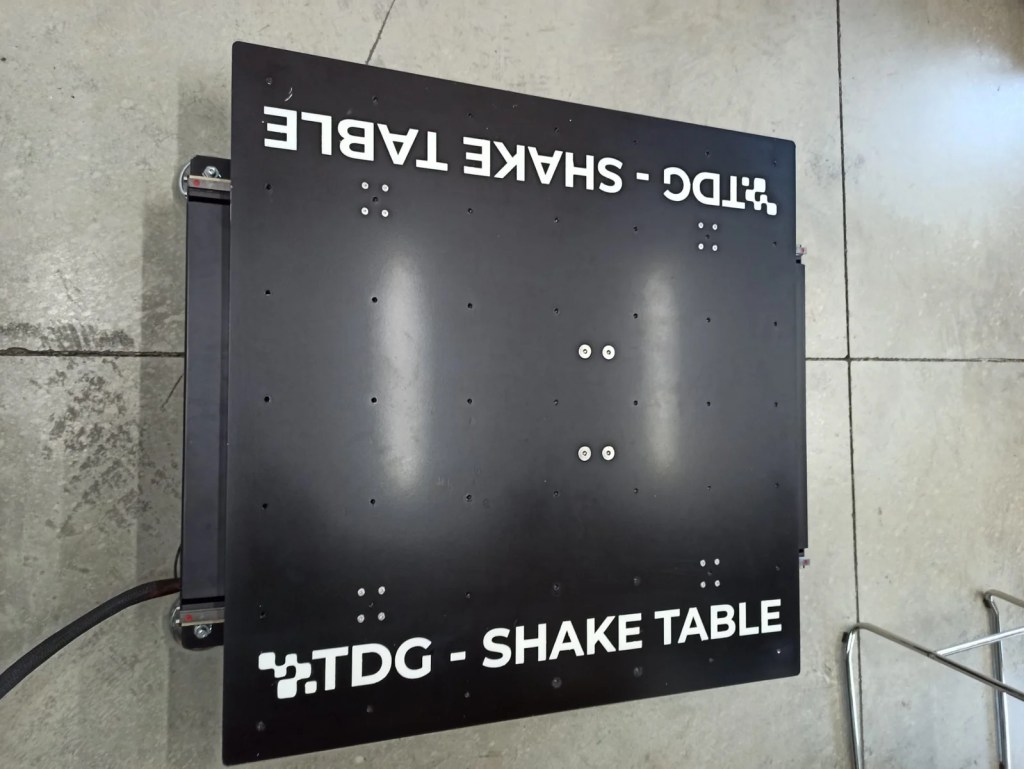
The QuakeLogic offers the 250-kg Shake Table, which is designed based on advanced engineering principles to simulate seismic activity for testing and research purposes. The structural framework consists of a robust, precision-engineered table platform supported by high-strength steel components. The platform can support up to 250 kg of test specimens.
The top table of the 1-axis system has dimensions of 100×100 cm (length by width) and a capacity of ±1g at 250 kg. It offers a stroke of ± 200 mm (total stroke of 400 mm) and operates using an electro-mechanical mechanism to generate precise and controlled movements. This system is integrated with high-fidelity sensor and actuator that translate electrical signals into physical motion, replicating the complex dynamics of earthquake waves. The control system uses real-time feedback mechanisms to ensure accuracy and repeatability of the simulations, making it an essential tool for structural and seismic testing.
Function:
The primary function of the 250-kg Shake Table is to provide a controlled environment for simulating seismic events. This equipment is designed to replicate ground motion by subjecting test specimens to a wide range of earthquake-induced vibrations in addition to signals such as sine wave, which are essential for comprehensive testing.
The product comes with EASYTEST PC control software, allowing for precise control and monitoring of the shake table’s operations. The EASYTEST is used for setting up test parameters, including the amplitude, frequency, and duration of the simulated earthquakes. This software enhances the usability of the system, making it accessible for both novice and experienced users.
Use Cases:
The QuakeLogic 250-kg Shake Table is used extensively in research, education, and industry for seismic testing and analysis. Its applications include:
- Structural Engineering Research: Universities and research institutions use the shake table to study the effects of earthquakes on various building materials and structural systems. This research is vital for developing new construction techniques and materials that can withstand seismic events.
- Civil Engineering Education: The shake table serves as a practical tool for educating civil engineering students about seismic design principles. It provides hands-on experience in understanding how structures behave under earthquake conditions.
- Seismic Certification and Testing: Manufacturers of construction materials and structural components utilize the shake table to certify their products’ seismic performance. This ensures that the products meet the necessary safety standards and regulatory requirements.
- Disaster Preparedness and Mitigation: Government agencies and organizations involved in disaster management use the shake table to develop and test mitigation strategies. This helps in improving building codes and enhancing the resilience of infrastructure against earthquakes.
- Commercial and Industrial Applications: The shake table is employed by engineering firms and construction companies for designing and testing innovative solutions for earthquake-resistant structures. This includes retrofitting existing buildings and designing new structures that comply with modern seismic standards.
Overall, the 250-kg Shake Table is an indispensable tool for advancing the understanding of seismic phenomena and improving the safety and resilience of structures in earthquake-prone regions.
To visit product page, click HERE.
For any further details or clarification, please do not hesitate to contact us directly at sales@quakelogic.net or call us at +1-916-899-0391.
Last reviewed: 2026-07-04
Executive Summary
Earthquake engineering connects ground motion, structural response, performance objectives, instrumentation, and post-event decision support. This article has been expanded as an engineering resource for readers evaluating earthquake engineering concepts, instrumentation choices, and monitoring workflows. The discussion is educational and should be paired with project-specific review by qualified engineers, applicable codes, owner requirements, and equipment documentation.
Key Takeaways
- Define the engineering objective before selecting sensors, test equipment, trigger thresholds, or reporting workflows.
- Use calibrated instrumentation, documented installation practices, time synchronization, and traceable data handling where measurement quality matters.
- Interpret measured data in context: site conditions, structure type, noise environment, sampling rate, bandwidth, and boundary conditions all affect conclusions.
- Use authoritative references and project-specific criteria rather than relying on generic thresholds or unsupported performance claims.
Technical Explanation
In practical earthquake engineering work, the engineering system is more than a sensor or a test platform. A credible workflow includes the measurement objective, instrument selection, mounting or boundary conditions, sampling and timing strategy, data validation, event or response detection, engineering review, and reporting. Weakness in any part of that chain can reduce confidence in the final interpretation.
For monitoring applications, engineers should document sensor orientation, coupling, environmental exposure, dynamic range, frequency bandwidth, data logger configuration, clock synchronization, communications, and maintenance procedures. For testing applications, engineers should document input motion, fixture design, payload properties, control limits, safety interlocks, acceptance criteria, and post-test data review.
Engineering Applications
| Application | Engineering Question | Typical Evidence Needed |
|---|---|---|
| Research and education | How does a structure, component, or sensor respond under controlled conditions? | Test plan, calibrated data, input motion, boundary conditions, and repeatable observations. |
| Critical infrastructure | Is the asset response normal, changing, or potentially unsafe after an event? | Baseline data, event records, thresholds, inspection workflow, and engineering sign-off. |
| Industrial facilities | Can monitoring support operational continuity and response decisions? | Site-specific criteria, reliable telemetry, alarm logic, maintenance records, and documented procedures. |
People Also Ask
What should be specified before buying equipment?
Specify the measurement objective, frequency range, amplitude range, environment, data format, timing needs, installation constraints, reporting requirements, and applicable standards or owner criteria.
Why do references and standards matter?
They provide terminology, acceptance criteria, test methods, and documentation expectations. They do not replace engineering judgment, but they reduce ambiguity and make results easier to review.
How should data quality be checked?
Review calibration status, timing, clipping, sensor orientation, signal-to-noise ratio, environmental artifacts, data completeness, and whether the record supports the engineering decision being made.
Related QuakeLogic Resources
- Mastering Seismic Data Accuracy: The Science Behind Seismic Corrections
- Why does Japan frequently experience earthquakes?
- Ironcore Biaxial Shake Table with Magnetic Motors: Precision and Power in Vibration Testing
- Maximizing Safety and Performance with Electrodynamic Eccentric Mass Shakers
- Related QuakeLogic products and technologies
- QuakeLogic Engineering Blog topic resources
References
Recommended Diagram or Download
Media placeholder: Add an original diagram showing the measurement chain from sensor or test platform to data acquisition, analysis, engineering interpretation, and reporting. Where this article becomes a buyer guide or application note, create a downloadable PDF version after engineering review.
Discuss a Monitoring or Testing Application
QuakeLogic supports seismic monitoring, earthquake early warning, structural health monitoring, infrasound monitoring, vibration monitoring, data acquisition, and shake table testing applications. For project-specific guidance, contact QuakeLogic with the asset type, measurement objective, site constraints, and required deliverables.

