Author: QuakeLogic

Engineering knowledge hub

QuakeLogic

Curated QuakeLogic articles, application notes, and technical explainers for engineering teams.

Areas of expertiseSeismic monitoring, structural health monitoring, testing systems, data acquisition, and applied engineering education.
Dam structural health monitoring system by QuakeLogic
Blog

Dam Structural Health Monitoring

Dam structural health monitoring is a vital necessity for modern hydroelectric facilities. Hydroelectric dams provide clean energy and support economies worldwide, but they face constant environmental pressures and seismic threats. Therefore, site...

Jul 12, 20263 min read

Step-by-Step Guide to Configure and Troubleshoot NTP on Linux-based Seismic Data Loggers by QuakeLogic

NTP Network Time Protocol, acronym technology concept on blackboard for "Step-by-Step Guide to Configure and Troubleshoot NTP on

1. SSH into Your OpenWrt Device

Open a terminal and SSH into your OpenWrt device:

ssh root@<your_openwrt_device_ip>

2. Verify NTP Configuration

Check the current NTP configuration:

uci show | grep ntp

3. Add NTP Servers to UCI Configuration

Add the NTP servers to the UCI system configuration:

uci add_list system.ntp.server='0.lede.pool.ntp.org'
uci add_list system.ntp.server='1.lede.pool.ntp.org'
uci add_list system.ntp.server='2.lede.pool.ntp.org'
uci add_list system.ntp.server='3.lede.pool.ntp.org'

4. Commit the Changes

Apply the changes to the configuration:

uci commit system

5. Restart the NTP Service

Restart the NTP service to apply the new configuration:

/etc/init.d/sysntpd restart

6. Verify Time Synchronization

Check the current date and time settings to ensure synchronization is working:

date

7. Ensure NTP Service Starts on Boot

Enable the NTP service to start on boot:

/etc/init.d/sysntpd enable

By following these steps, your OpenWrt device will be configured to use the specified NTP servers, and the system time will be synchronized correctly.


Manually Sync Time with an NTP Server

1. SSH into Your OpenWrt Device

Open a terminal and SSH into your OpenWrt device:

ssh root@<your_openwrt_device_ip>

2. Stop the NTP Service

Stop the NTP service to avoid conflicts:

/etc/init.d/sysntpd stop

3. Manually Sync Time with an NTP Server

Use the ntpd command to manually sync the time with an NTP server:

ntpd -q -p 0.lede.pool.ntp.org

The -q option tells ntpd to set the time and quit, and the -p option specifies the NTP server.

4. Start the NTP Service Again

Start the NTP service to resume automatic synchronization:

/etc/init.d/sysntpd start

5. Verify Time Synchronization

Check the current date and time to ensure it has been updated correctly:

date

By following these steps, you can manually sync the time on your OpenWrt device with a specific NTP server.


Troubleshooting “ntpd: bad address ‘0.lede.pool.ntp.org'”

1. Check DNS Configuration

Ensure your OpenWrt device can resolve domain names correctly:

ping google.com

If this fails, you might need to configure your DNS settings manually in the /etc/config/network file:

uci set network.wan.dns='8.8.8.8 8.8.4.4'
uci commit network
/etc/init.d/network restart

2. Verify NTP Package Installation

Ensure that the ntpd package is installed:

opkg update
opkg install ntpd

3. Manually Sync Time Using ntpd with IP Address

If DNS issues persist, use the IP address of the NTP server instead of the hostname:

ntpd -q -p 162.159.200.123

4. Ensure NTP Servers Are Correctly Configured in UCI

Check and reconfigure the NTP servers if necessary:

uci show system.ntp
uci delete system.ntp.server
uci add_list system.ntp.server='0.lede.pool.ntp.org'
uci add_list system.ntp.server='1.lede.pool.ntp.org'
uci add_list system.ntp.server='2.lede.pool.ntp.org'
uci add_list system.ntp.server='3.lede.pool.ntp.org'
uci commit system

5. Restart the NTP Service

Restart the NTP service to apply the changes:

/etc/init.d/sysntpd restart

By following these steps, you should be able to resolve the “ntpd: bad address ‘0.lede.pool.ntp.org'” error and ensure your OpenWrt device can correctly sync time with the NTP servers.


By following these organized steps, you should be able to configure, manually sync, and troubleshoot NTP settings on your OpenWrt device effectively.

For questions, reach us at support@quakelogic.net. Our working hours are 8 AM to 5 PM Pacific Time (M-F).

Last reviewed: 2026-07-04

Executive Summary

Data acquisition systems synchronize, digitize, store, transmit, and quality-check sensor signals used in seismic, vibration, acoustic, and SHM workflows. This article has been expanded as an engineering resource for readers evaluating data acquisition systems concepts, instrumentation choices, and monitoring workflows. The discussion is educational and should be paired with project-specific review by qualified engineers, applicable codes, owner requirements, and equipment documentation.

Key Takeaways

  • Define the engineering objective before selecting sensors, test equipment, trigger thresholds, or reporting workflows.
  • Use calibrated instrumentation, documented installation practices, time synchronization, and traceable data handling where measurement quality matters.
  • Interpret measured data in context: site conditions, structure type, noise environment, sampling rate, bandwidth, and boundary conditions all affect conclusions.
  • Use authoritative references and project-specific criteria rather than relying on generic thresholds or unsupported performance claims.

Technical Explanation

In practical data acquisition systems work, the engineering system is more than a sensor or a test platform. A credible workflow includes the measurement objective, instrument selection, mounting or boundary conditions, sampling and timing strategy, data validation, event or response detection, engineering review, and reporting. Weakness in any part of that chain can reduce confidence in the final interpretation.

For monitoring applications, engineers should document sensor orientation, coupling, environmental exposure, dynamic range, frequency bandwidth, data logger configuration, clock synchronization, communications, and maintenance procedures. For testing applications, engineers should document input motion, fixture design, payload properties, control limits, safety interlocks, acceptance criteria, and post-test data review.

Engineering Applications

ApplicationEngineering QuestionTypical Evidence Needed
Research and educationHow does a structure, component, or sensor respond under controlled conditions?Test plan, calibrated data, input motion, boundary conditions, and repeatable observations.
Critical infrastructureIs the asset response normal, changing, or potentially unsafe after an event?Baseline data, event records, thresholds, inspection workflow, and engineering sign-off.
Industrial facilitiesCan monitoring support operational continuity and response decisions?Site-specific criteria, reliable telemetry, alarm logic, maintenance records, and documented procedures.

People Also Ask

What should be specified before buying equipment?

Specify the measurement objective, frequency range, amplitude range, environment, data format, timing needs, installation constraints, reporting requirements, and applicable standards or owner criteria.

Why do references and standards matter?

They provide terminology, acceptance criteria, test methods, and documentation expectations. They do not replace engineering judgment, but they reduce ambiguity and make results easier to review.

How should data quality be checked?

Review calibration status, timing, clipping, sensor orientation, signal-to-noise ratio, environmental artifacts, data completeness, and whether the record supports the engineering decision being made.

Related QuakeLogic Resources

References

Recommended Diagram or Download

Media placeholder: Add an original diagram showing the measurement chain from sensor or test platform to data acquisition, analysis, engineering interpretation, and reporting. Where this article becomes a buyer guide or application note, create a downloadable PDF version after engineering review.

Discuss a Monitoring or Testing Application

QuakeLogic supports seismic monitoring, earthquake early warning, structural health monitoring, infrasound monitoring, vibration monitoring, data acquisition, and shake table testing applications. For project-specific guidance, contact QuakeLogic with the asset type, measurement objective, site constraints, and required deliverables.

How to Prepare an Annual Seismic Monitoring and Early Warning Hardware Compliance Report: A Guide from QuakeLogic

Annual Hardware Compliance Report

Ensuring that all seismic monitoring hardware within an organization meets regulatory standards, safety requirements, and internal guidelines is crucial for maintaining operational integrity and compliance. At QuakeLogic, we understand the importance of systematic procedures to achieve this goal. Here’s a detailed outline on how to prepare an Annual Seismic and Early Warning Monitoring Hardware Compliance Report:

1. Inventory Assessment

  • Objective: Compile a comprehensive list of all hardware assets, including dataloggers, sensors, computers, servers, network equipment, and any other relevant hardware.

2. Regulatory and Standards Review

  • Objective: Ensure compliance with current regulations and standards applicable to your hardware, which may include industry-specific regulations, data protection standards like GDPR, and safety standards.

3. Hardware Inspection and Testing

  • Objective: Conduct physical inspections and functional tests to verify that each piece of hardware is operating safely and correctly, checking for wear and tear or other potential issues.

4. Software and Firmware Compliance

  • Objective: Check that all hardware is running the latest approved software and firmware versions to ensure optimal security and functionality.

5. Documentation Review

  • Objective: Review all relevant documentation for hardware, including purchase records, warranty information, and maintenance logs, ensuring everything is up-to-date.

6. Compliance Gap Analysis

  • Objective: Identify any discrepancies between the actual state of the hardware and compliance requirements, noting outdated or non-compliant equipment.

7. Risk Assessment

  • Objective: Assess the risks associated with identified compliance gaps, determining their potential impact and prioritizing them accordingly.

8. Remediation Plan

  • Objective: Develop strategies to address identified compliance issues, which may involve hardware upgrades, additional maintenance, or new safety protocols.

9. Reporting

  • Objective: Compile a detailed report summarizing the findings, risk assessments, and proposed remediation plans.

10. Submission and Review

  • Objective: Submit the report to relevant authorities and hold review sessions with stakeholders to discuss the findings and next steps.

11. Implementation of Recommendations

  • Objective: Execute the remediation plans to rectify compliance issues and ensure all hardware meets required standards.

12. Continuous Monitoring and Updates

  • Objective: Establish ongoing monitoring processes to continuously assess and update the compliance status of hardware.

By adhering to these steps, organizations can maintain their hardware in compliance with all pertinent regulations and standards, thus minimizing risks and bolstering operational effectiveness.

A template report can be downloaded from HERE.

For any questions regarding the process or to seek guidance on specific compliance challenges, feel free to contact us at support@quakelogic.net or call us at +1-916-899-0391. We’re here to help you ensure that your hardware systems are safe, compliant, and optimally functioning.

Last reviewed: 2026-07-04

Executive Summary

Earthquake early warning combines rapid detection, local or regional algorithms, alert logic, and response procedures before strong shaking reaches a site. This article has been expanded as an engineering resource for readers evaluating earthquake early warning concepts, instrumentation choices, and monitoring workflows. The discussion is educational and should be paired with project-specific review by qualified engineers, applicable codes, owner requirements, and equipment documentation.

Key Takeaways

  • Define the engineering objective before selecting sensors, test equipment, trigger thresholds, or reporting workflows.
  • Use calibrated instrumentation, documented installation practices, time synchronization, and traceable data handling where measurement quality matters.
  • Interpret measured data in context: site conditions, structure type, noise environment, sampling rate, bandwidth, and boundary conditions all affect conclusions.
  • Use authoritative references and project-specific criteria rather than relying on generic thresholds or unsupported performance claims.

Technical Explanation

In practical earthquake early warning work, the engineering system is more than a sensor or a test platform. A credible workflow includes the measurement objective, instrument selection, mounting or boundary conditions, sampling and timing strategy, data validation, event or response detection, engineering review, and reporting. Weakness in any part of that chain can reduce confidence in the final interpretation.

For monitoring applications, engineers should document sensor orientation, coupling, environmental exposure, dynamic range, frequency bandwidth, data logger configuration, clock synchronization, communications, and maintenance procedures. For testing applications, engineers should document input motion, fixture design, payload properties, control limits, safety interlocks, acceptance criteria, and post-test data review.

Engineering Applications

ApplicationEngineering QuestionTypical Evidence Needed
Research and educationHow does a structure, component, or sensor respond under controlled conditions?Test plan, calibrated data, input motion, boundary conditions, and repeatable observations.
Critical infrastructureIs the asset response normal, changing, or potentially unsafe after an event?Baseline data, event records, thresholds, inspection workflow, and engineering sign-off.
Industrial facilitiesCan monitoring support operational continuity and response decisions?Site-specific criteria, reliable telemetry, alarm logic, maintenance records, and documented procedures.

People Also Ask

What should be specified before buying equipment?

Specify the measurement objective, frequency range, amplitude range, environment, data format, timing needs, installation constraints, reporting requirements, and applicable standards or owner criteria.

Why do references and standards matter?

They provide terminology, acceptance criteria, test methods, and documentation expectations. They do not replace engineering judgment, but they reduce ambiguity and make results easier to review.

How should data quality be checked?

Review calibration status, timing, clipping, sensor orientation, signal-to-noise ratio, environmental artifacts, data completeness, and whether the record supports the engineering decision being made.

Related QuakeLogic Resources

References

Recommended Diagram or Download

Media placeholder: Add an original diagram showing the measurement chain from sensor or test platform to data acquisition, analysis, engineering interpretation, and reporting. Where this article becomes a buyer guide or application note, create a downloadable PDF version after engineering review.

Discuss a Monitoring or Testing Application

QuakeLogic supports seismic monitoring, earthquake early warning, structural health monitoring, infrasound monitoring, vibration monitoring, data acquisition, and shake table testing applications. For project-specific guidance, contact QuakeLogic with the asset type, measurement objective, site constraints, and required deliverables.

ACEBOX: Ultimate High-Fidelity Solution for Comprehensive Building Seismic Monitoring

acebox 1 for "ACEBOX: Ultimate High-Fidelity Solution for Comprehensive Building Seismic Monitoring"

QuakeLogic proudly presents the ACEBOX accelerographs, the ultimate solution for comprehensive building seismic monitoring. Our high-fidelity accelerographs feature triaxial force balance accelerometers, an integrated datalogger, GPS, and Ethernet capabilities.

These sophisticated instruments are strategically placed at the roof, mid-level, and ground level of buildings to ensure accurate and reliable seismic data collection, as shown in the schematic below.

The ACEBOX is a compact all-in-one high-resolution accelerograph based on the reliable and field-proven SL06 recorder. It embeds three force balance accelerometers of the SA10 series, allowing for efficient and fast deployment. Within seconds of activation, the system is operational. Encased in robust, corrosion-resistant aluminum, the ACEBOX can be deployed in the field indefinitely with minimal environmental protection. Its weight and durability guarantee excellent ground coupling, and flexible data connectivity allows direct linkage to your central observatory. The ultra-fast SeedLink server accelerates data streaming up to 10 packets per second, making the ACEBOX the best option for Earthquake Early Warning Systems (EEWS).

acebox 1 for "ACEBOX: Ultimate High-Fidelity Solution for Comprehensive Building Seismic Monitoring"

Key features of the SARA ACEBOX include:

  • Ultra-low noise design with an embedded FBA sensor featuring ultra-low noise and cross-axis sensitivity
  • GPS synchronization with options for PPS or NTP when GPS is unavailable
  • Wide power supply voltage range and internal NiMh battery for safe shutdown on power failure
  • Edge computing capabilities, including alerting algorithms like P-wave analysis
  • Ultra-fast SeedLink streaming protocol or custom protocols with substreaming capability
  • Networking options including TCP, SSH, FTP, HTTP, ModBus, MQTT, Telnet, Telegram, and SMS
  • VPN readiness for operation behind firewalls and NAT filters
  • High-capacity local data storage and real-time measurements according to the UNI9916 norm
  • Automatic frequency peak-picking with frequency shifting alarm reports
  • Easy web browser configuration and management
  • IP68 protection grade for harsh environments

Applications for the ACEBOX include EEWS, aftershock studies, reservoir microseismic monitoring, operational modal analysis (OMA), and structural health monitoring (SHM).

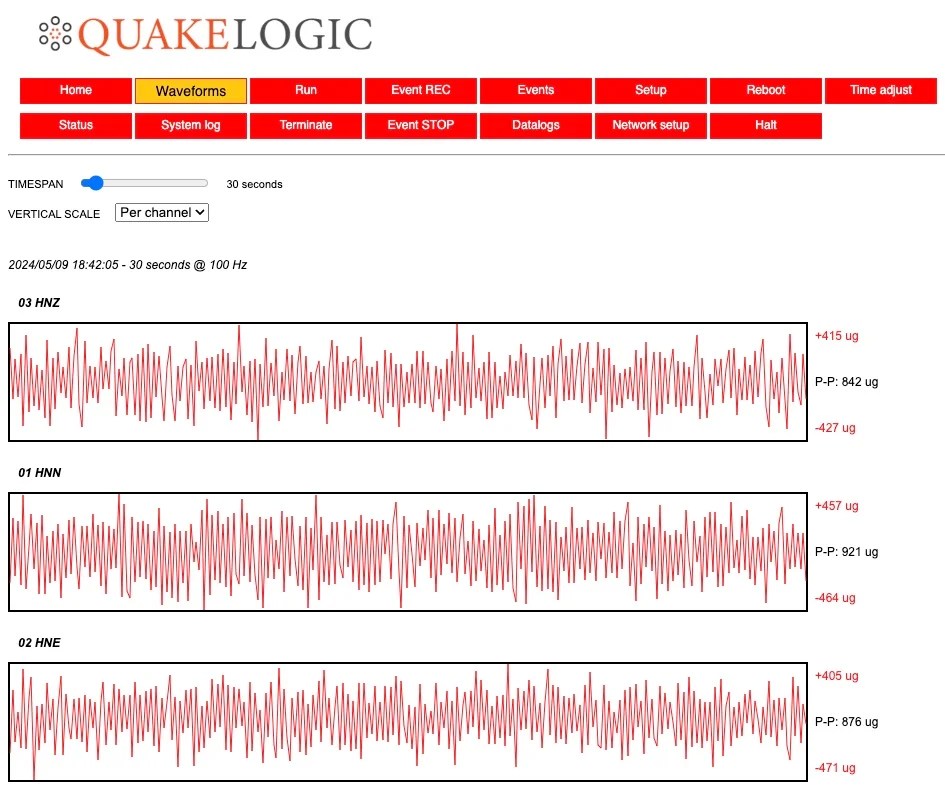
The GUI of ACEBOX is extremely easy to use and navigate.

Our accelerographs are designed to meet and exceed industry code regulations and standards, ensuring the highest level of safety and performance. The ACEBOX provides precise data essential for structural health monitoring and safety assessments, making it an invaluable tool for engineers and building managers.

For more information and sales inquiries, please contact us at sales@quakelogic.net or visit our product website at SARA ACEBOX Accelerographs.

Seismic monitoring instrumentation for "ACEBOX: Ultimate High-Fidelity Solution for Comprehensive Building Seismic Monitoring"
Screenshot

About QuakeLogic

QuakeLogic is a leading provider of advanced seismic monitoring solutions, offering a range of products and services designed to enhance the accuracy and efficiency of seismic data acquisition and analysis. Our innovative technologies and expert support help organizations worldwide to better understand and mitigate the impacts of seismic events.

Contact Information
Emailto:sales@quakelogic.net
Phone: +1-916-899-0391
WhatsApp: +1-650-353-8627
Website: www.quakelogic.net

For more information about our products and services, please visit our website or contact our sales team. We are here to help you with all your seismic monitoring needs.

Thank you for choosing QuakeLogic. We look forward to assisting you with your seismic monitoring projects.

Last reviewed: 2026-07-04

Executive Summary

Data acquisition systems synchronize, digitize, store, transmit, and quality-check sensor signals used in seismic, vibration, acoustic, and SHM workflows. This article has been expanded as an engineering resource for readers evaluating data acquisition systems concepts, instrumentation choices, and monitoring workflows. The discussion is educational and should be paired with project-specific review by qualified engineers, applicable codes, owner requirements, and equipment documentation.

Key Takeaways

  • Define the engineering objective before selecting sensors, test equipment, trigger thresholds, or reporting workflows.
  • Use calibrated instrumentation, documented installation practices, time synchronization, and traceable data handling where measurement quality matters.
  • Interpret measured data in context: site conditions, structure type, noise environment, sampling rate, bandwidth, and boundary conditions all affect conclusions.
  • Use authoritative references and project-specific criteria rather than relying on generic thresholds or unsupported performance claims.

Technical Explanation

In practical data acquisition systems work, the engineering system is more than a sensor or a test platform. A credible workflow includes the measurement objective, instrument selection, mounting or boundary conditions, sampling and timing strategy, data validation, event or response detection, engineering review, and reporting. Weakness in any part of that chain can reduce confidence in the final interpretation.

For monitoring applications, engineers should document sensor orientation, coupling, environmental exposure, dynamic range, frequency bandwidth, data logger configuration, clock synchronization, communications, and maintenance procedures. For testing applications, engineers should document input motion, fixture design, payload properties, control limits, safety interlocks, acceptance criteria, and post-test data review.

Engineering Applications

ApplicationEngineering QuestionTypical Evidence Needed
Research and educationHow does a structure, component, or sensor respond under controlled conditions?Test plan, calibrated data, input motion, boundary conditions, and repeatable observations.
Critical infrastructureIs the asset response normal, changing, or potentially unsafe after an event?Baseline data, event records, thresholds, inspection workflow, and engineering sign-off.
Industrial facilitiesCan monitoring support operational continuity and response decisions?Site-specific criteria, reliable telemetry, alarm logic, maintenance records, and documented procedures.

People Also Ask

What should be specified before buying equipment?

Specify the measurement objective, frequency range, amplitude range, environment, data format, timing needs, installation constraints, reporting requirements, and applicable standards or owner criteria.

Why do references and standards matter?

They provide terminology, acceptance criteria, test methods, and documentation expectations. They do not replace engineering judgment, but they reduce ambiguity and make results easier to review.

How should data quality be checked?

Review calibration status, timing, clipping, sensor orientation, signal-to-noise ratio, environmental artifacts, data completeness, and whether the record supports the engineering decision being made.

Related QuakeLogic Resources

References

Recommended Diagram or Download

Media placeholder: Add an original diagram showing the measurement chain from sensor or test platform to data acquisition, analysis, engineering interpretation, and reporting. Where this article becomes a buyer guide or application note, create a downloadable PDF version after engineering review.

Discuss a Monitoring or Testing Application

QuakeLogic supports seismic monitoring, earthquake early warning, structural health monitoring, infrasound monitoring, vibration monitoring, data acquisition, and shake table testing applications. For project-specific guidance, contact QuakeLogic with the asset type, measurement objective, site constraints, and required deliverables.